


Daytime VFX Artist, Nighttime Maker
Few makers on MakerWorld have an IMDb filmography. Daniel Mueri is one of them.
Cargo, 2009

Daniel Mueri is on IMDb for the 2009 Swiss sci-fi film Cargo, made on a budget of roughly €5 million. The special effects were handled by a team of nine, all 3D and VFX artists—including a twenty-one-year-old with no industry experience. That twenty-one-year-old was Daniel.
That 21-year-old newcomer was Daniel.
"It was my dream to make a sci-fi movie, and this was my first chance to get into the industry. It was a great experience."
Before landing this job, he showcased his work on his website. Someone saw it and called him. Although he didn't have a portfolio from a formal production company, the work accumulated online was enough to get him an opportunity. He spent a full year working on Cargo. After that year, he co-founded Cloudscape with two colleagues from the crew.
Fifteen years later, the company is still operating steadily. Today, Cloudscape primarily serves commercial clients in Switzerland: advertising videos, product animations, and educational materials. Each project typically lasts two weeks, then the next one begins. And this is Daniel's favorite part: each case is a different world, a different problem, a different perspective, giving him access to things ordinary people never get to see.
"Recently, I worked for Pilatus, a Swiss aircraft manufacturing company. They build planes, and I got to observe the entire manufacturing process to create animations for their new models."
There was also a nuclear power plant project. They had access to every room in the facility, gaining deep insight into how uranium is stored, and produced a documentary-style animation of the entire process.
"Every year, we get to see amazing places all over Switzerland, and being able to see these different things all the time is the coolest part of my job."
Compositor, not Modeler

About half of Cloudscape's work is compositing, not animation. It mainly involves compositing 3D renders into live-action footage, tracking camera movements, and smoothing the transition between virtual and shot footage. Technically, it's very different from modeling, but it still requires meticulous observation.
For years, Daniel himself wasn't particularly keen on touching the modeling part.
The reason is simple: in his projects, models are merely a means, not an end. In a two-week commercial task, no one models from scratch; you either buy pre-made models or use product scans, followed by animation, lighting, rendering, and compositing.
"In our daily work, we don't actually do modeling. I think I haven't done it for fifteen years because it's only a small part of the job."
During those fifteen years, models only existed on screen, as scene layers, rendering tools, or temporary objects. The models themselves never truly captivated him.
Until 3D printers changed everything.
"I never liked the modeling part since I started doing 3D. But in the last two years, I've found that I can do 3D modeling, print it out, and then hold it in my hands. This feeling has greatly changed me."
Models were no longer just layers; they became tangible objects.
Ender, Bambu Lab A1, and four kilograms of filament

His first experience with 3D printing was typical: in 2021, he owned an Ender. Daniel wanted to make a case for an ESP module, so he bought a printer to do it. The Ender did its job, but then it broke down.
"I think it broke down about once every two months, and quite badly."
By 2024, he had a more serious project: building a hydroponic vegetable tower for his balcony. The openings needed to be large enough to grow tomatoes, not just lettuce. And the structure needed to be stable enough to withstand wind without needing to be fixed to a wall.


He searched online but couldn't find a solution that met both criteria.
He tried a popular design on Printables that many others had used. After printing and assembling it, he observed carefully:
"This won't work. It's too small for vegetables. The structure isn't stable; I'd have to put a lot of effort into reinforcing it."
So he decided to design it himself. When printing with the Ender, it couldn't handle the entire print bed because the edges were always poorly calibrated. He needed better equipment.
Friends mentioned Bambu Lab, and Daniel also considered Prusa, but it was too expensive. The Creality K1 felt too large. Finally, because his wife advised him not to buy anything too big or too expensive, he chose the A1.
He admits it was the best decision he could have made at the time. He bought it right after the recall, so he immediately received the improved version.
"The Bambu Lab A1 works great, almost maintenance-free. I just let it do what I want it to do, without having to worry about managing it."

The first hydroponic tower consumed four kilograms of filament. The prototype is still on his balcony.
The second version was completed in September 2024 and uploaded to MakerWorld in April 2025. It has been downloaded over 6,200 times.
Castle Design Contest

For several months, Daniel used Shapr3D, a CAD app on his iPad, to design hydroponic towers, a bottle washer for a brewing friend, and several simple, practical objects. He enjoyed working on the couch without sitting at his workstation.
But CAD gradually ceased to inspire new ideas; hydroponics and bracket design were reaching a bottleneck.
Until he saw a contest on MakerWorld, the theme of which was castles.
"This was essentially the starting point for my 3D printing creations. Before that, I had never designed an object purely for its 'looks'; it was always function-oriented. The castle was my first piece designed and printed purely for aesthetic appreciation."
The contest changed the way the question was posed. Daniel began asking himself: "How can this look good?" instead of just "How does it work?"
He returned to using Cinema 4D—Maxon software he had been using for over fifteen years in his career.
Parametric CAD modeling and polygonal modeling are fundamentally different. In CAD, you input numbers and get shapes; polygonal modeling is like sculpting clay, pulling vertices, and handcrafting. Precision, logic, and patience are all entirely different.
Cinema 4D offers a unique feature: the Volume Builder. It combines multiple objects into a single solid, fills gaps, and automatically generates a closed mesh for easy export.
"You can put any object into the Volume Builder, and it integrates them. It generates about a million polygons for each object, which is heavy on the CPU, but it has a big advantage."
The advantage is the ability to apply depth maps to the generated shapes, such as brick textures or wood grains. Each surface can automatically have a structured texture without manual sculpting.
Daniel developed this workflow on his own while designing the castle. The initial version used stone wall textures and a bit of wood grain, serving as a test for the feasibility of the idea, which proved successful.
Since then, this technique has defined the aesthetic of all his works.
Style
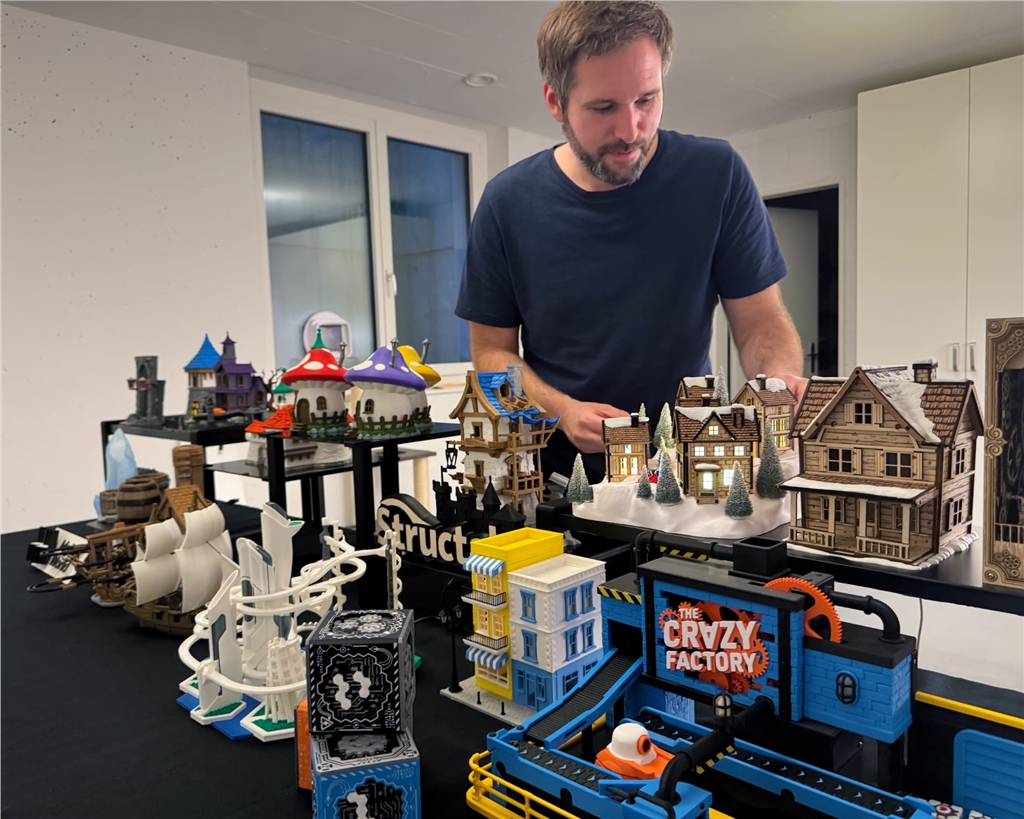
Whenever he starts a new project, Daniel spends a lot of time browsing ArtStation and Pinterest, looking for forms that make him stop scrolling. He doesn't seek straight lines but prefers slightly Disney-esque, fairy-tale-like, and somewhat realistic lines, always with a beauty somewhere in between.
Most projects on MakerWorld come from CAD software, precise and sharply defined, with geometrically-driven shapes. Daniel's goal is different.
"I always wanted to make something that looks like a movie prop. As long as it's filmed from the right angle, it can create an atmosphere."
Some might want to label his style, but he doesn't. Instead, he points to Disneyland, which sounds surprising.
"It sounds stupid, but I love Disneyland, I love roller coasters. I won't make roller coasters, but my work should be something like Disneyland combined with a roller coaster. This is also what led me to make marble runs."
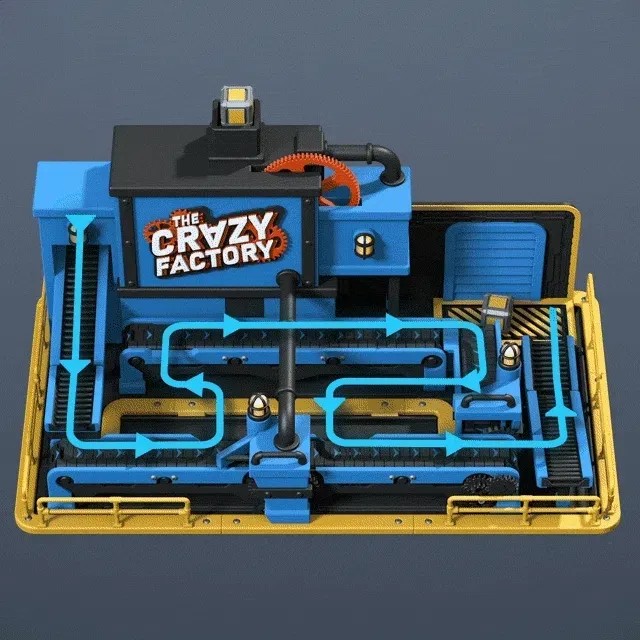
Marble runs are a logical extension of this aesthetic; they're not just for display but also for the viewer to enjoy their operation, even captivating someone for half an hour watching them run.
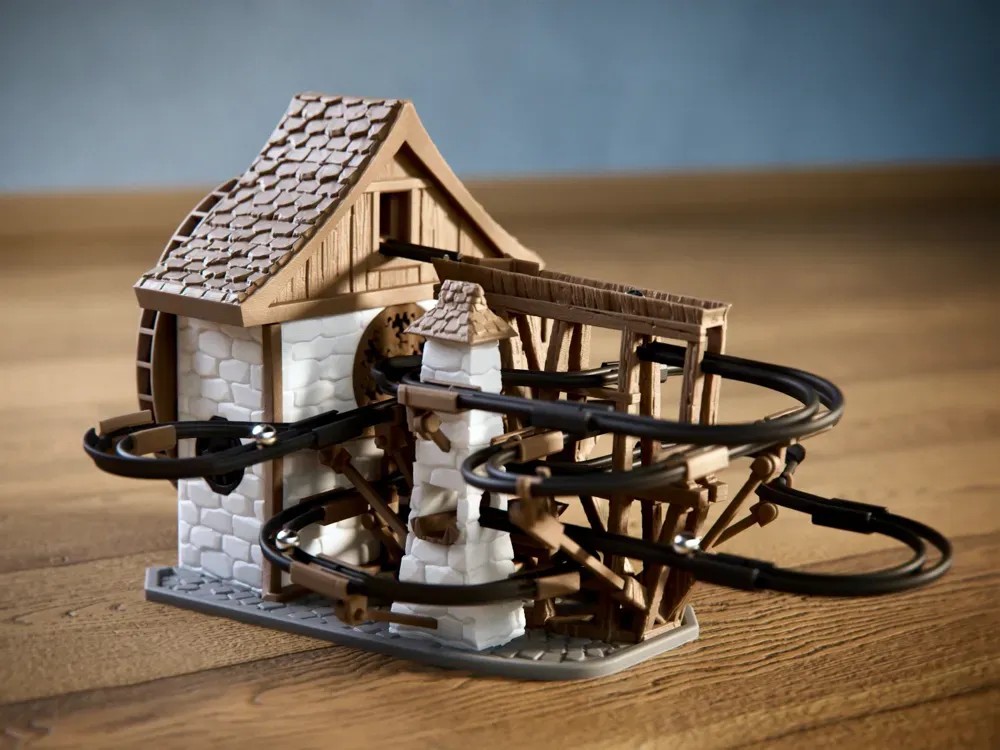
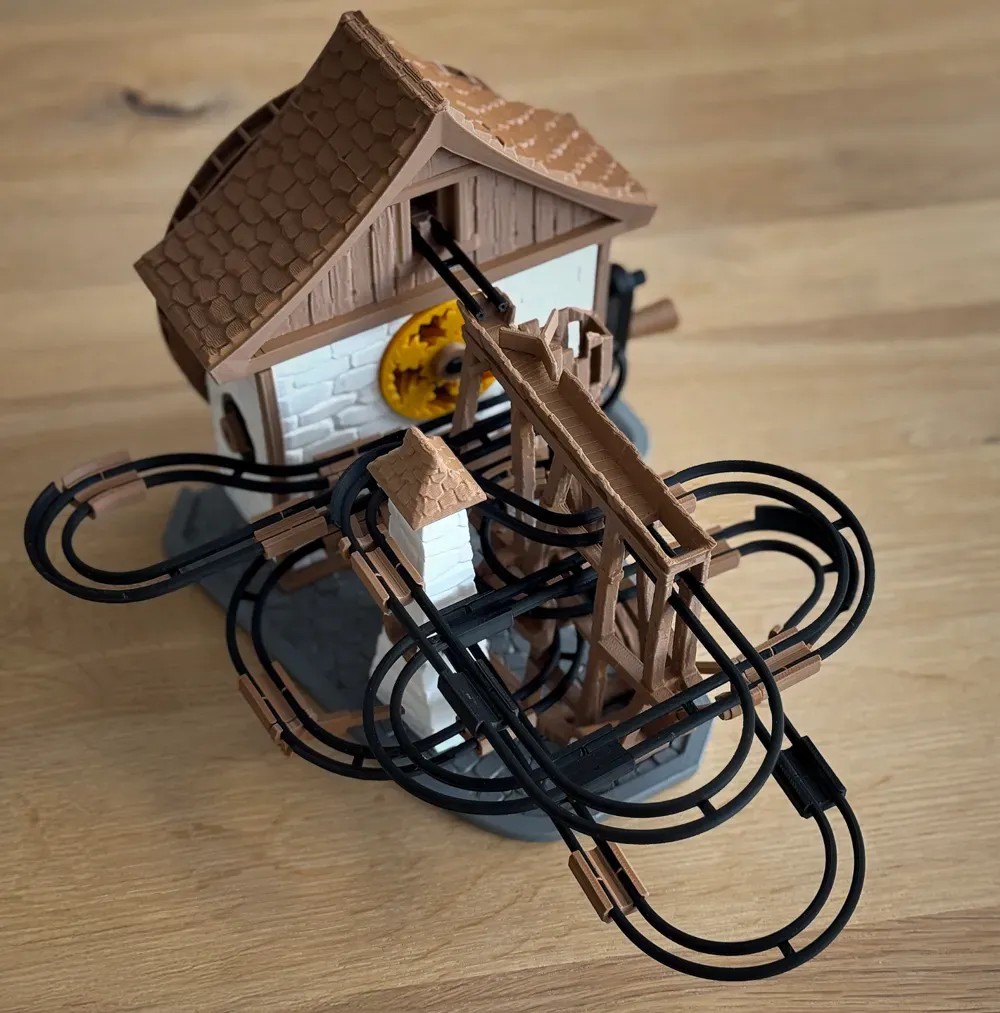
Source: Water Mill Marble Run [MakerWorld]
However, Daniel's work has another characteristic that sets it apart from most on the platform: monochrome, multi-part printing, then manual assembly.
Each part is printed independently, and multi-color AMS printing is avoided unless absolutely necessary.
"From the beginning, my goal was to create monochrome objects that require assembly."
He believes that complex structures completed by combining multiple pieces have a greater physical presence than products printed as a single block, and it also makes them easily accessible to those without AMS.
Works
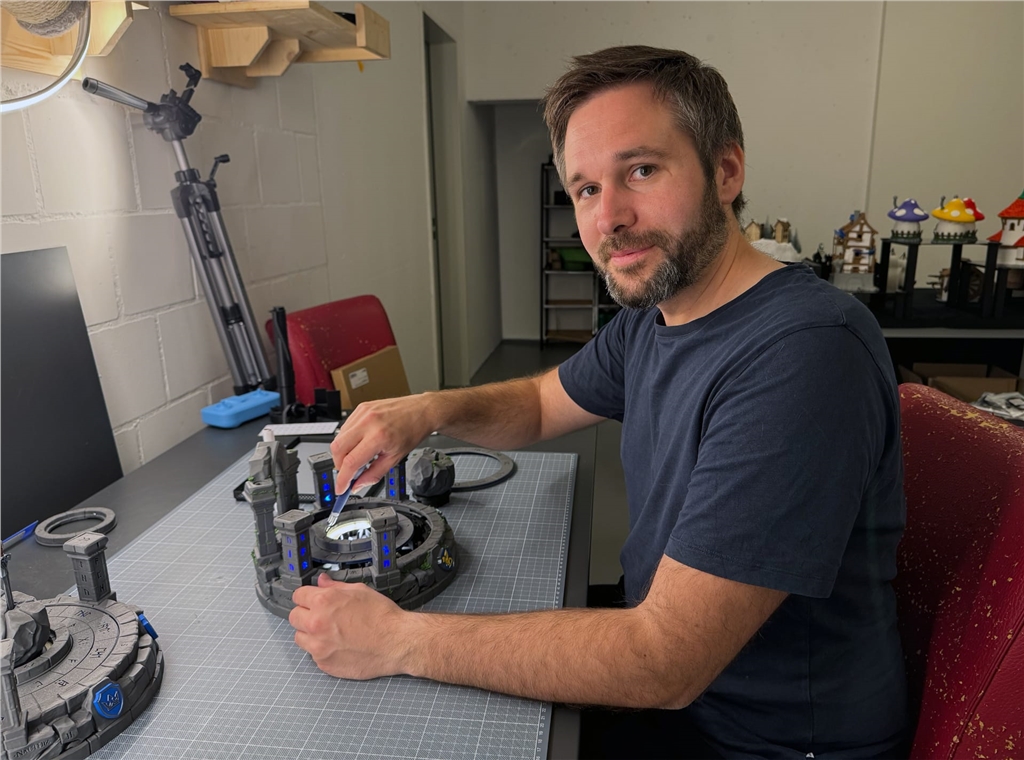
If he were to show his work to someone unfamiliar with it, he would introduce the Water Mill Marble Run or Metropolis Neohexa—a futuristic sci-fi city where marbles travel on tracks above the streets.
"It's really great when kids gather around and can sit and watch for a full thirty minutes."
His most outstanding design is the Haunted House. It assembles quickly, uses off-the-shelf components from Maker's Supply, and features the consistent curved style seen in his work.
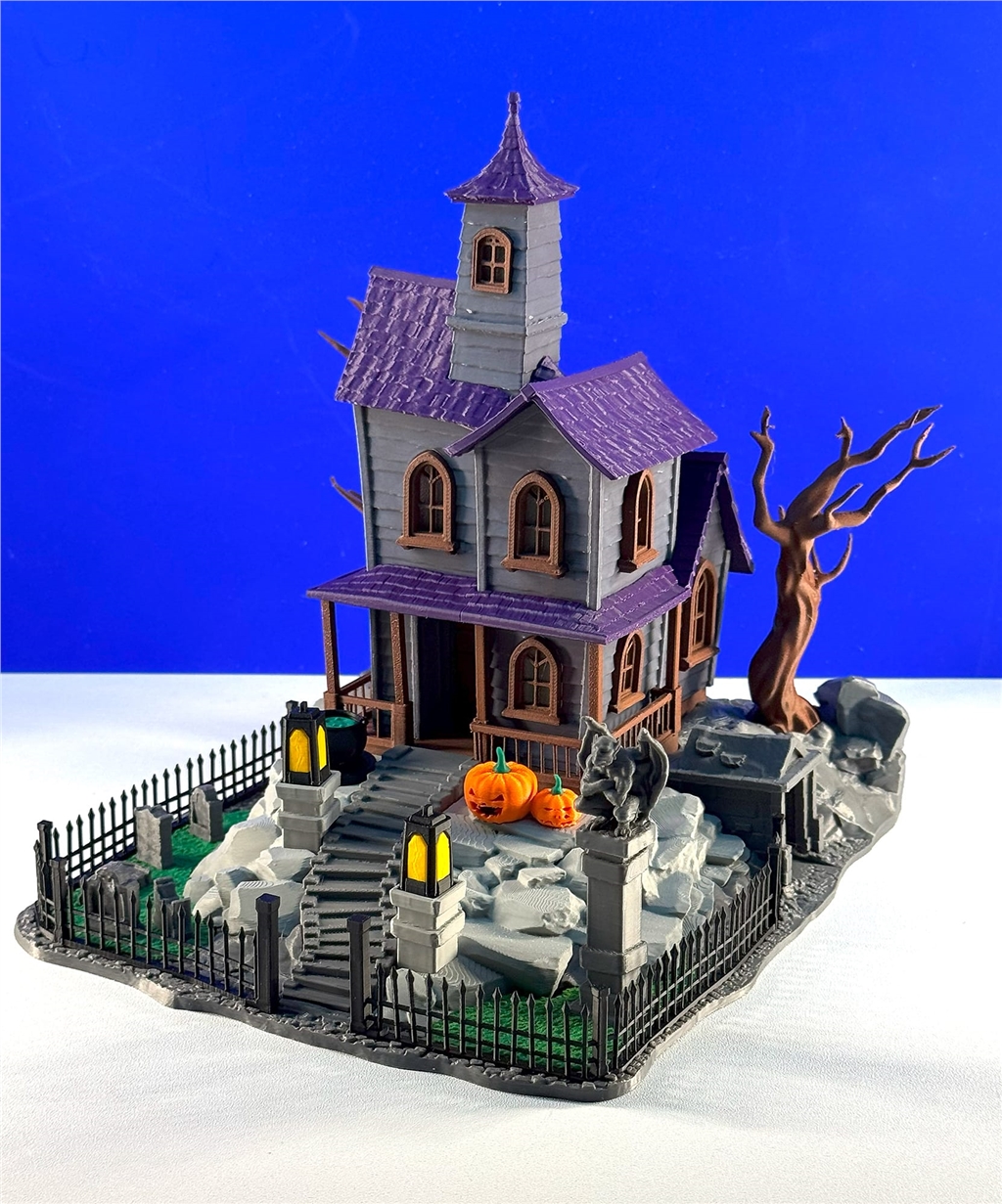
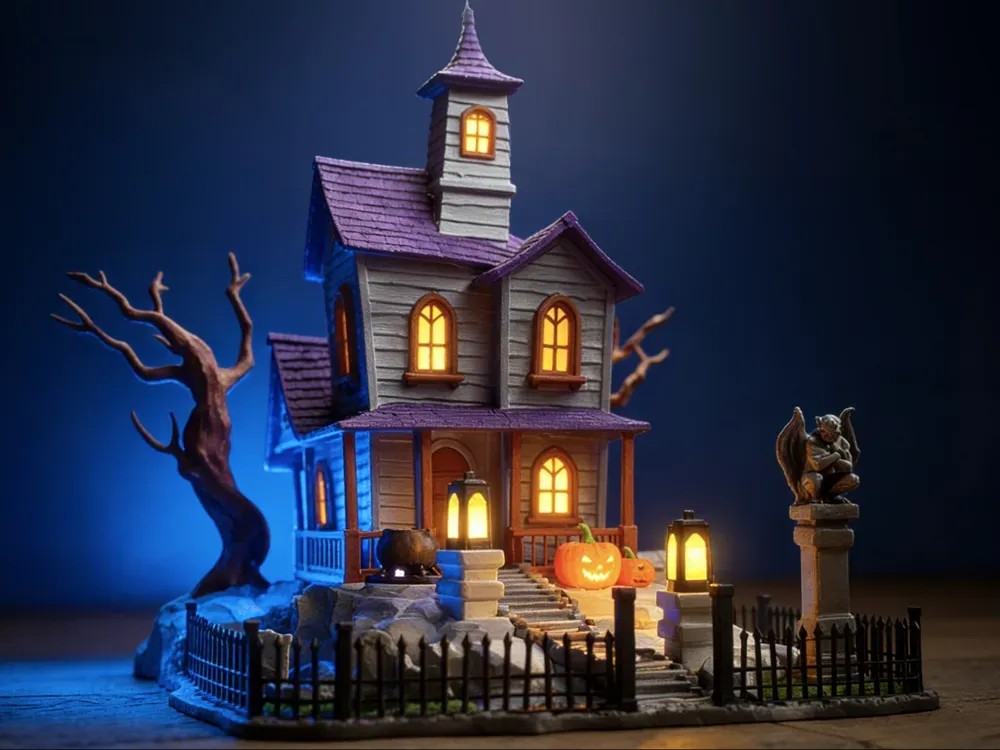
Source: Haunted House - A Halloween Scene [MakerWorld]
And the Mushroom Cottage...
"I have a model called the Mushroom Cottage. It was just a small, simple filler project, but everyone loved it. I could have done more with it."
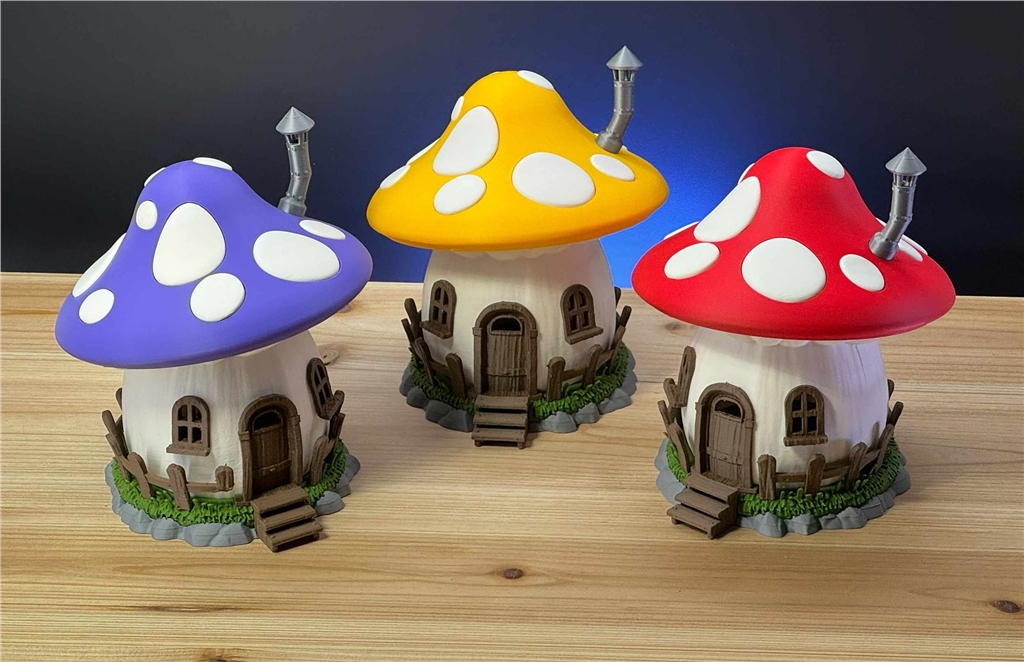
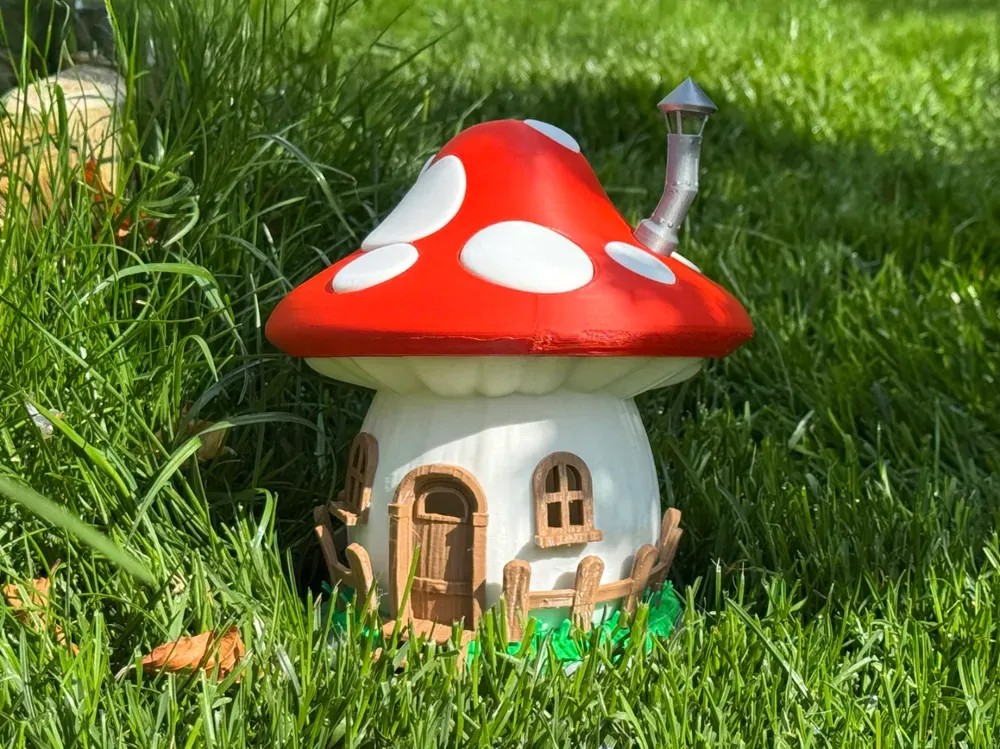
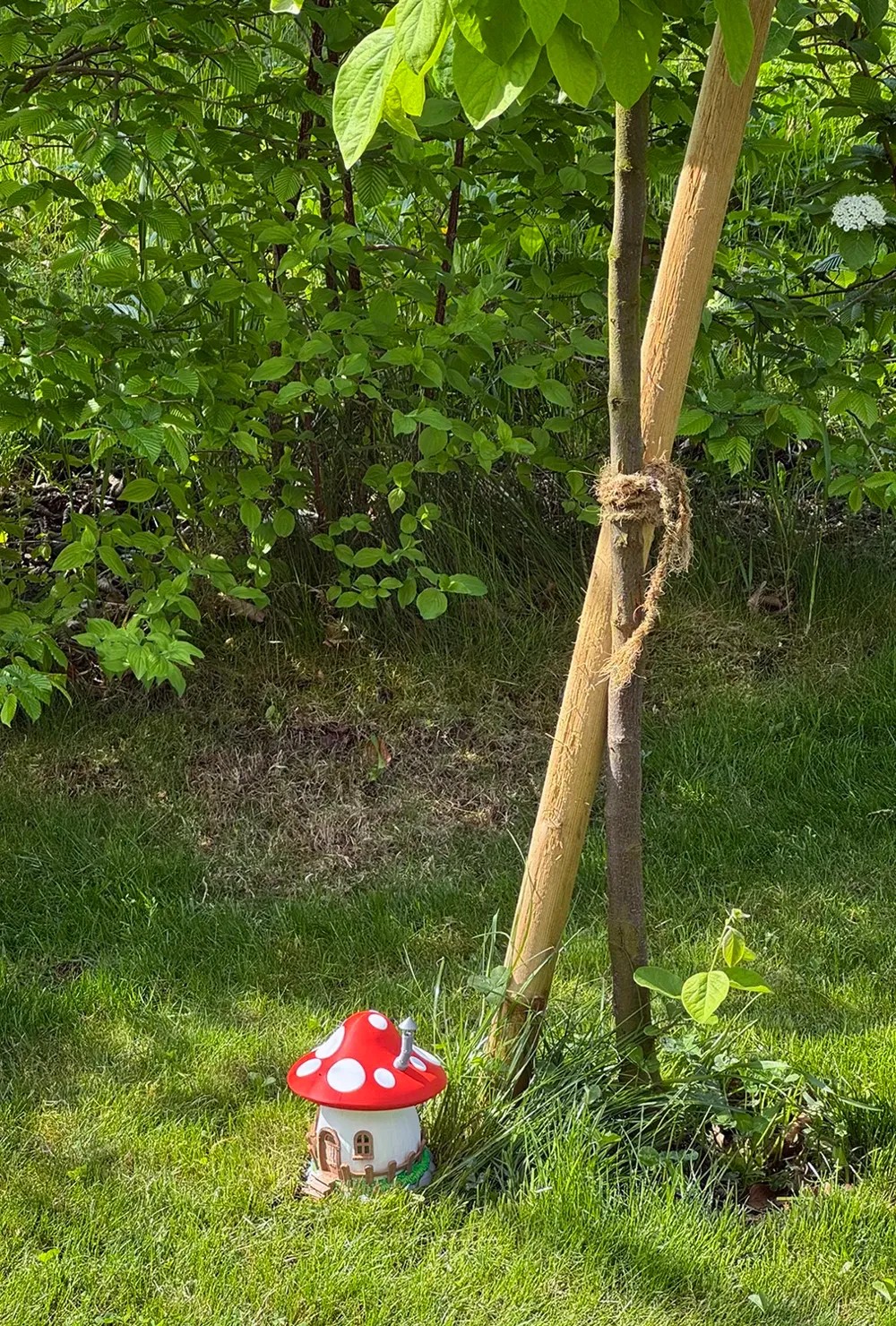
Source: Mushroom Cottage - Garden Decoration [MakerWorld]
The biggest disappointment was Hearts Unlocked, a mechanical puzzle box that requires hours to assemble and is quite innovative when held in hand.
Unfortunately, almost no one completed the assembly.
"It offers cool gameplay and solutions, but I don't think anyone actually finished it. Maybe those fifteen people did..."

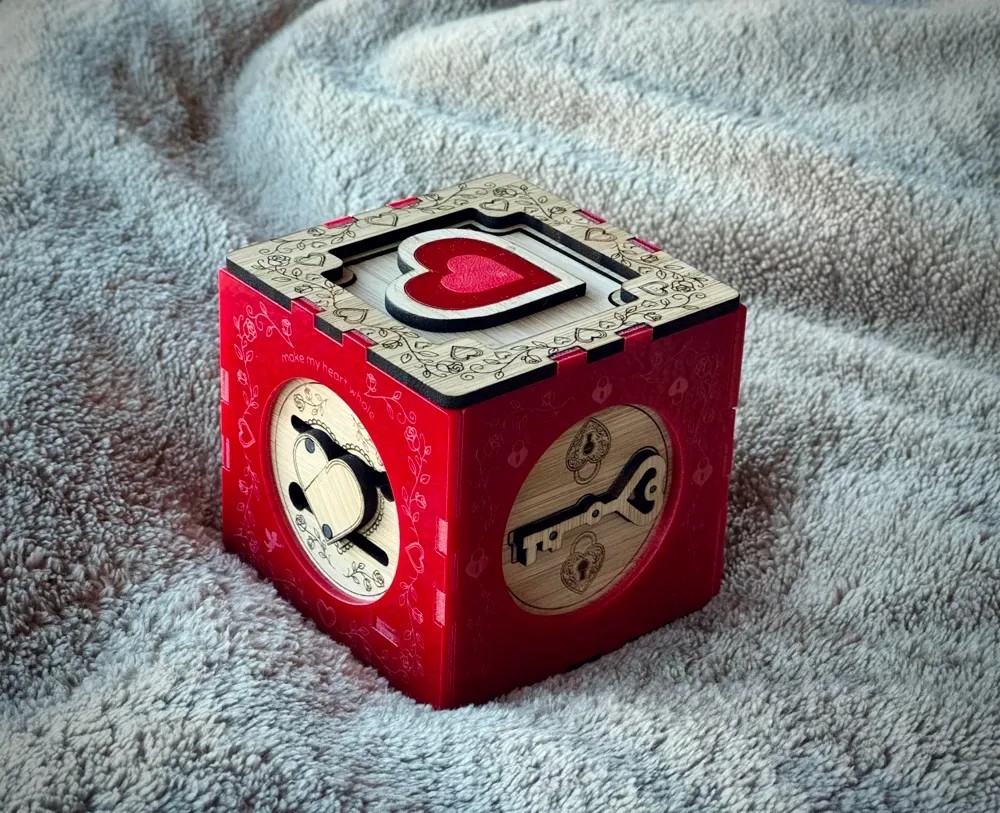
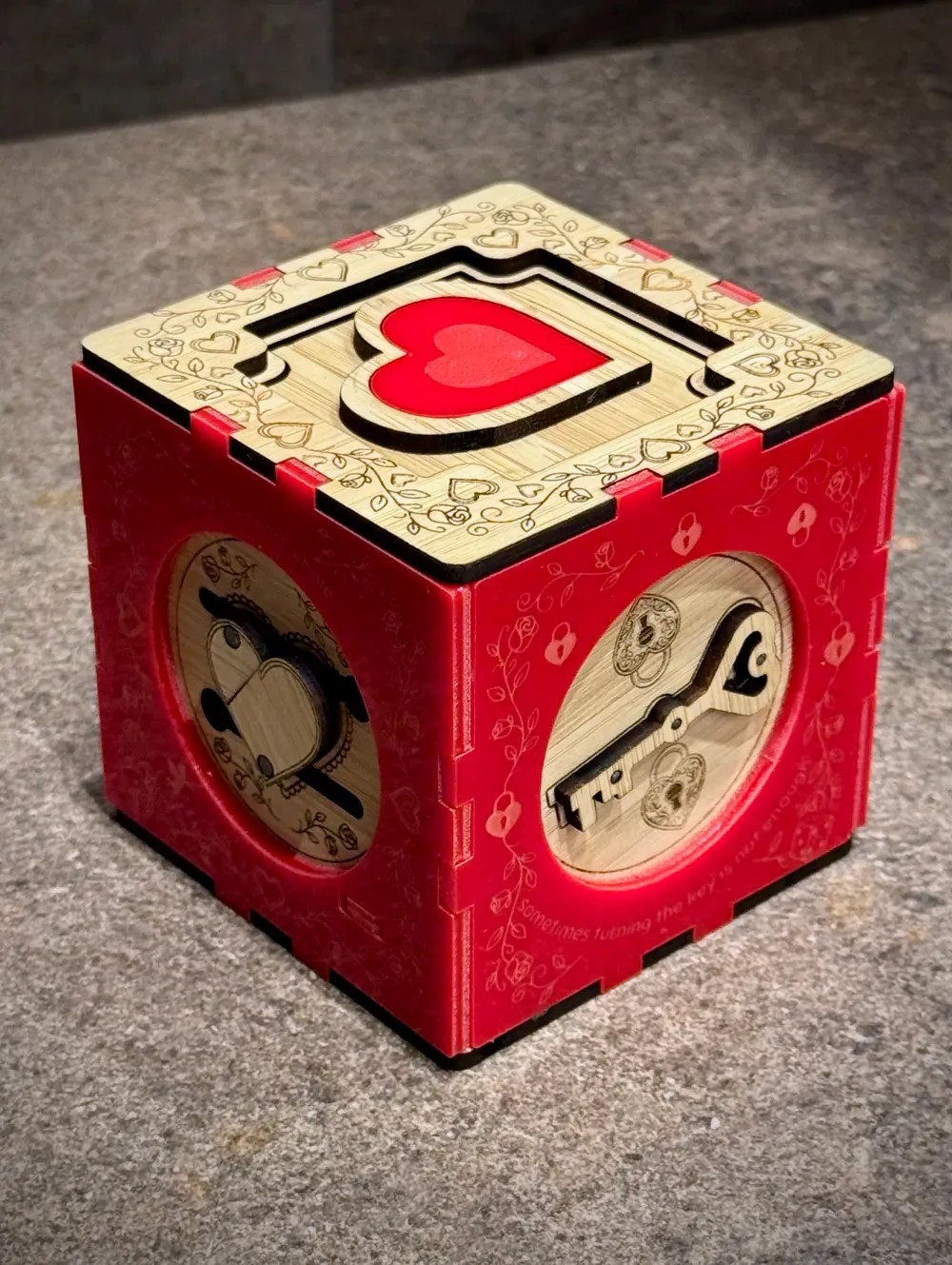
Source: Hearts Unlocked - Mechanical Puzzle Box [MakerWorld]
He speaks of it without bitterness; it's simply how things turned out.
The Winter Village is another chapter.
It combines laser-engraved wood with 3D prints: wooden houses with carved facade textures, snow-covered trees, sleds climbing hills via lifts, LED lights inside houses, and animations controlled by motors and a Maker's Supply power board.
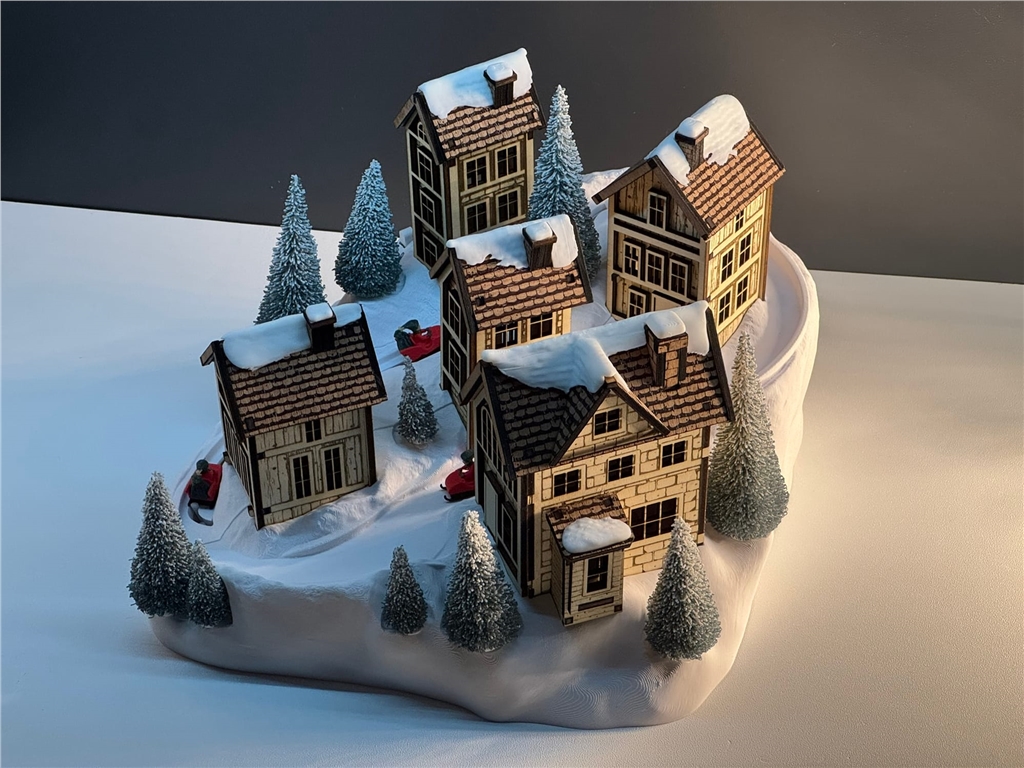
The entire project started with a single element—the tree!
"When I was making the Winter Village, I thought, the tree has to be sorted first. If I can't find a tree I like, the whole model won't work. Get the tree right, then talk about everything else."
The tree went through over ten print iterations before the layered coloring mechanism worked correctly.
.jpg)
Later, he wanted the sled to travel along two interconnected paths, crossing a bridge. He tried for weeks.
But it never succeeded.
"It's the hardest part when you have to give up most of what you've worked so hard on."
He abandoned that design, and the rest of the piece was completed immediately.
.jpg)
Source: Winter Village - Sled Hill Diorama [MakerWorld]
Excalibur was a crowdfunding project. A sword, a column with a locking mechanism, a hidden drawer inside the column, and runes carved on the stone. Daniel first created 3D renders before printing the parts.
Reddit reacted coolly to the renders.
"Reddit mostly said it was AI stuff, but those were 3D renders of actual printed models."
Then he printed a preliminary version without the mechanical parts, added a few LEDs to prove its physical existence, and then launched the fundraiser.
Bambu Lab H2D and Laser Engraving
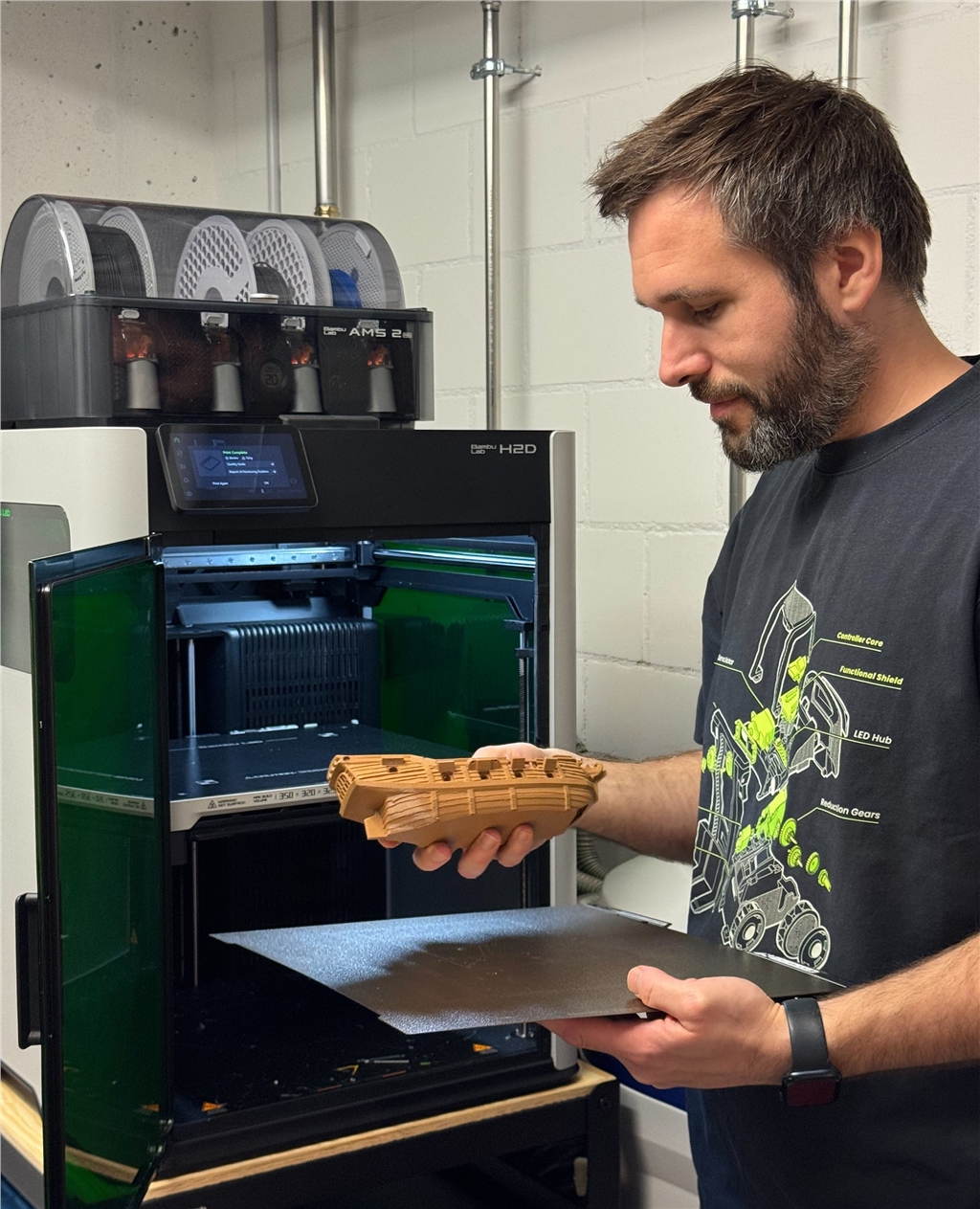
Daniel learned about the H2D printer through Dora Ding at MakerWorld. Dora Ding asked him if he would be willing to try using a laser. Daniel, of course, gladly agreed, even though he had never considered venturing into laser cutting or woodworking before.
"I had never thought about buying a laser cutter or getting into woodworking before. But then Dora asked me on the Discord channel if I wanted to do some laser cutting? Of course, I didn't refuse, because I thought—oh, this is great!"
He quickly made a discovery: wood, with textures directly engraved onto the material, possesses an aesthetic that 3D printing alone cannot replicate.
"As a designer, I prefer the look and feel of wood. I love it too much."
He now owns two A1 printers and one H2D printer. Whenever a project requires it, he switches modules between the laser head and the print head, cleans the machine, and moves on to the next project.
It's easy to operate, requiring no special skills.Crowdfunding
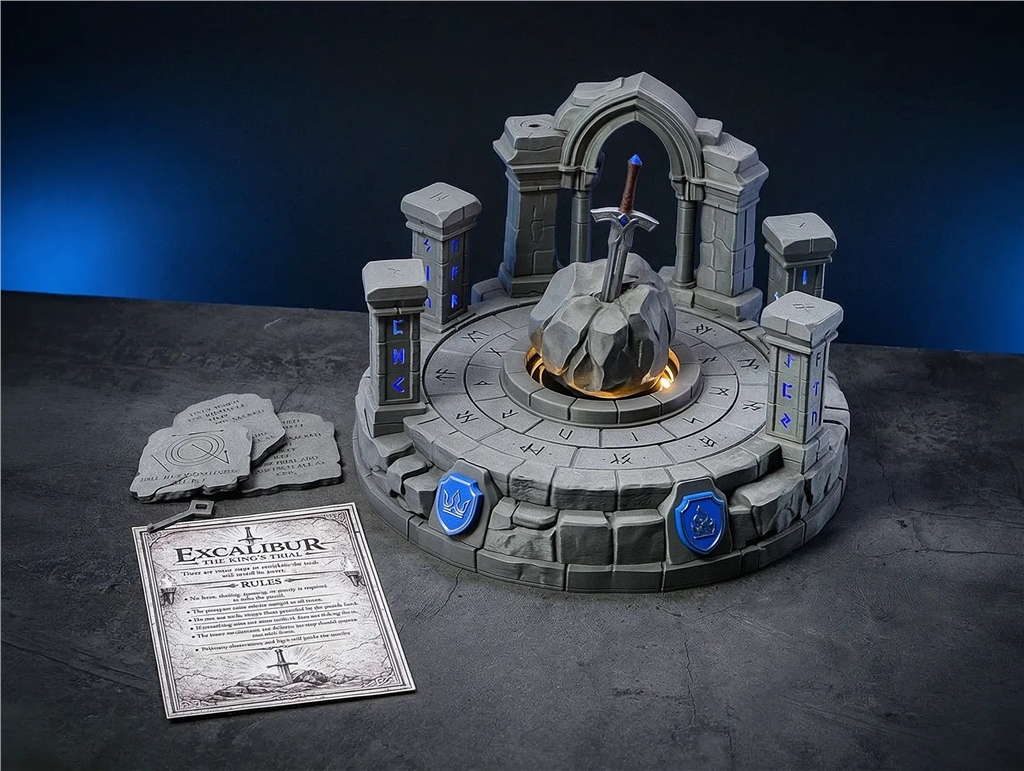
Source: Excalibur - Escape Room on Your Table [MakerWorld]
Daniel has done two crowdfunding campaigns on MakerWorld, one of which raised $11,000. He admits that money is indeed a motivator, but he has mixed feelings about fundraising...
"Every time I do a crowdfunding campaign, halfway through it feels too much like work. I have to satisfy my 'customers.' It's something like that."
The moment someone pays for a product, the relationship between creator and project changes. A hobby becomes a task. Responsibility to an external audience enters a space previously occupied only by curiosity. Free models don't carry that weight.
The Core Box—one of his favorite objects—always sits on his desk. The assembly instructions are a challenge, and Daniel knows it. However, he recently updated the instructions with a short animation, which has been very helpful.
"I want constructive feedback, or good feedback. That's what I'm looking for in crowdfunding models. So I put a lot of effort into getting that part right."
In crowdfunding projects, everything has to be polished: good print profiles, detailed instructions, testing on several machines. That's work, not play. He knows the difference very well.
His Creative Process
The process always begins with a feeling. Browsing Pinterest, stopping at something that catches the eye. More references, AI-generated variations as starting points for composition, a rough layout in Cinema 4D to check if proportions make sense from all angles.
"There's always an inner drive that makes me want to try."
He doesn't draw. He admits he's slow and clumsy at modeling. But he knows what the final result should look like and works towards that. He always starts with a critical element—that element must work first for the rest to exist. In the Winter Village, it was the trees. In Excalibur, it was the sword and the first pillar. In marble runs, it's the lift mechanism—it must function before any surrounding parts are designed.
"It's always the same process. I start with a specific part of the model that's in my mind."
For projects involving mechanical structures, prototyping can be an exercise in patience. The Winter Village's sled mechanism went through ten print iterations before it finally worked. When the mechanism failed, Daniel printed another version. When it succeeded, he moved on.
He admits with a hint of self-deprecation that his print profiles are often released before the second prototype is even finished.
"I have to admit, sometimes the first print profile for my new project is a beta test..."
He hasn't experienced creative blocks. Since joining MakerWorld, he always knows what he wants to do next. Now, after Excalibur, he already has another idea waiting: a wooden marble run combining laser processing and 3D printing.
For Himself, Not for the Algorithm
.jpg)
Before MakerWorld, Daniel had no social media footprint at all. He worked during the day and stayed away from computers at night. For years, he never publicly displayed any of his personal creative works.
His first upload to MakerWorld was a sponge holder with a soap dish, dated December 2, 2024. There was almost no interaction. But he liked the convenience of uploading images and descriptions, and how the platform neatly organized his projects. He started using it as his personal database.
Now he reads every comment and replies to most of them.
"I really enjoy replying to comments. I hate leaving comments unanswered. I don't have a goal for how many followers to have, or how many designs to publish. I just want to feel happy again with a new model. The project idea must come from me."
He has no goals for the number of models or followers. He hasn't thought about making a living from MakerWorld because he already has his own company and genuinely loves his job. Projects start with him and end with engagement from the community. Free models are released when he personally feels ready. Crowdfunding projects are launched when they are sufficiently developed. This distinction is important to him, and he carefully maintains it.
Missing Feedback in Comments
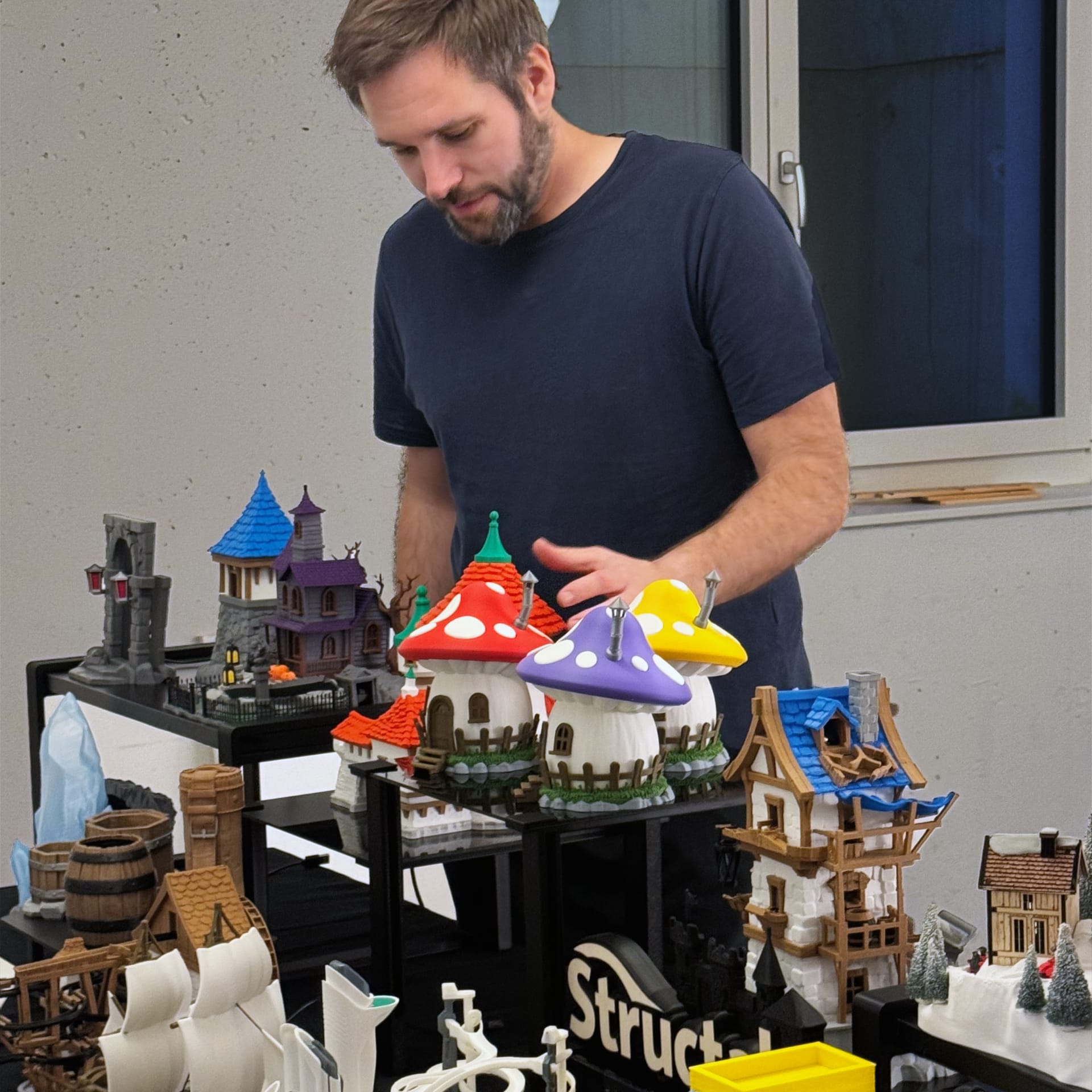
In June, Daniel will have a dedicated booth at a maker faire in Switzerland. He plans to bring everything he's ever made—a plan that's been a year in the making. Because there's a type of feedback he can't get online: the reaction when someone holds his objects in their hands. Hearing how mechanical structures work, touching the texture of castle walls, watching marbles roll through the water mill marble run and back to the top.
"Getting this kind of feedback on physical models is something I've been dreaming about since last year. Online, most of the feedback I get is about my photos, or whether the print profile is good or bad. But regarding the actual function, how it looks as a physical object, I don't get much feedback."
Online, people see photos. In person, they see objects.
This might be the shortest description of Daniel Mueri's creative philosophy. For fifteen years, he created things that only existed on screen. Now, he creates things that people can hold, operate, assemble, place on shelves, show to children—or take to the balcony and place next to that hydroponic tower growing tomatoes.
Two worlds, one person.
Daytime: nuclear reactors and Pilatus aircraft. Nighttime: castles, marble runs, and wooden villages with sleds.
He didn't truly start enjoying modeling until models were no longer just a layer in a file, but something he could hold in his hands.
The rest is up to the printer.
- Contact Us -
3DMart offers more than just 3D printing; we provide three major contract services: "3D Printing Service," "3D Scanning Service," and "Spatial 3D Scanning Service"!!
Follow our fan pages and stay informed:
Facebook | Instagram | Threads | LinkedIn