


[Spatial Scan] Six Luxury Hotel Marketing Strategies to Build a High-End Brand Image
Luxury hotel marketing is not just about selling rooms and amenities; more importantly, it is about using brand storytelling, immersive experiences, and precise segmentation to allow high-value guests to understand and feel the unique value offered by the brand before they even arrive.
Key Takeaways
- Luxury hotel marketing should promote identity, emotional experience, and transformation, rather than just rooms and facilities. Unique brand stories, heritage, exquisite design, and signature experiences are what truly support premium pricing.
- Affluent guests are not a monolithic audience; leveraging guest data to tailor content for different segments can build loyalty and reduce reliance on OTAs.
- Immersive 3D virtual tours make luxury properties accessible before booking, allowing guests to explore suites, amenities, layouts, and featured experiences instead of relying on static photos.
- Matterport 3D spatial scanners offer virtual tours that, combined with interactive tags, guided tours, and property intelligence, help hotels showcase experiences, personalize virtual property journeys, and establish consistent property descriptions.
Affluent travelers tend to choose brands that offer a sense of exclusivity, uniqueness, and value for money. They rarely select a hotel based solely on price. Instead, they decide long before arrival based on how the hotel makes them feel and whether it aligns with their expectations.
This instinct makes the high-end market exceptionally competitive. Hotels must prove their value before guests even consider the amenities. The most effective strategies for engaging these guests involve emotion-driven storytelling and immersive spatial experiences. When high-value guests can visualize their stay in detail, they can book with greater confidence.
This guide covers six luxury hotel marketing strategies to help you reach affluent clientele and build a high-end image for your brand.
1. Build Differentiation Through Story, Heritage, and Design
Booking a luxury room is about purchasing an experience and a lifestyle, not just paying more for a room. When two properties are similar in room type, spa facilities, or service ratings, the brand with a distinct identity is more likely to win the booking. An elegant and unique brand story elevates a property from "comfortable" to "unforgettable."
Transform elements that are leverageable and impossible for competitors to replicate into the core of your marketing:
- Property Origins: The story behind its founding, restoration, or reinvention.
- History and Heritage: Architecture, past guests, and significant cultural moments.
- Location and Local Culture: How the community, landscape, and local customs shape the guest experience.
- Service Philosophy: The specific ways your team anticipates and cares for guests.
Explicitly name these assets and place them at the center of your marketing narrative: visuals should deliberately highlight unique details, copy should consistently tell the story, videos should show the story in action, and social content should reinforce the same tone over time. When guests see a consistent voice and story everywhere, the brand will appear more intentional and substantial.
For example, The Beverly Hills Hotel centers its brand on "privacy and attentive service," long-positioned as a celebrity hideaway. Meanwhile, Loire Valley Lodges in Touraine, France, uses the theme "Let the forest enter you," highlighting woodland imagery and local materials, with everything from website copy to shop items tracing back to the land and scenery.
2. Invest in High-End Visuals to Make Properties Feel Tangible Online
Visuals determine a guest's price expectations before they read a single word of text. Photography, video, social assets, websites, and e-brochures must all match the quality of the onsite experience: shoot using the light and moments that best represent the space, and maintain a consistent tone across all formats, from the hero video to the smallest social media crop.
However, even the most exquisite static photos have limits. Photos represent fragments, whereas immersive formats, such as 3D virtual tours , convey a sense of space and flow more completely.
In a navigable 3D model, guests can tour signature suites, villas, sea-view rooms, spas, restaurants, and event spaces as if they were visiting in person. Compared to scrolling, immersive experiences capture more attention; listings with virtual tours see 3x longer engagement times than those with traditional photos.
3D models offer multiple perspectives:
- Immersive roaming via eye-level digital twins.
- Floor plans to view circulation and room relationships.
- "Dollhouse" view to quickly understand the scale and flow of a villa or the entire layout.
These presentations answer questions that static photos cannot: size, connectivity, and overall configuration. Creating content that invites guests to "step inside" shifts the focus from price and thumbnails to letting guests feel the stay in advance.
3. Highlight Signature Experiences
Affluent travelers won't remember or recommend a hotel based solely on the room; signature experiences—such as wellness retreats, private dining, exclusive tours, spa rituals, or local cultural activities—make a stay a "destination-worthy" journey.
Package signature experiences as "transformative itineraries" rather than just a list of amenities: upgrade "spa access" to a "seasonal ritual," and tell stories based on the results guests will achieve, rather than just listing what the hotel provides.
"Show" these experiences using visuals and interaction instead of letting guests imagine them. In virtual tours, you can add interactive Tags at the exact locations where experiences occur. Place a tag on the chef’s table, in the treatment room, or at the start of a nature trail; potential guests can click to view content during the tour. This is more persuasive than a single line of text on an amenity page; users can piece together the entire experience within the tour.
For a stronger narrative effect, create Guided Tours that lead guests from the arrival courtyard to the suite and then to the rooftop restaurant, presenting in the most compelling sequence, as if a concierge were giving a VIP a personal tour.
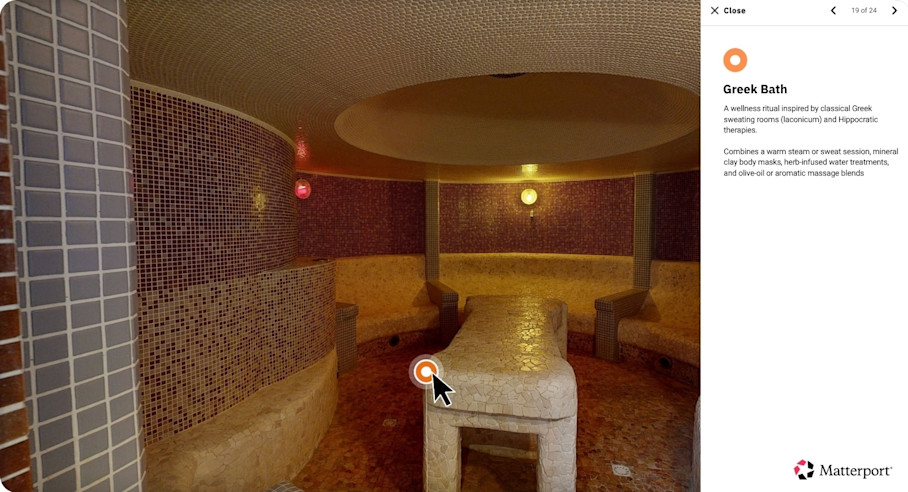
When presented properly, a signature experience can become the primary motivation for booking: for example, a sunrise hammam ritual paired with a private terrace breakfast. Combinations like this are rarely listed on amenity lists, yet they can attract guests to pay extra for the experience.
Example: Lindner Hotels & Resorts allows potential guests to view spas or outdoor bamboo houses before booking, helping them decide before reserving a massage or dinner. Highlighting signature experiences early also increases the likelihood of guests making add-on purchases during their stay, thereby raising the total order value.
4. Leverage Guest Stories and Social Proof
Authentic guest narratives are more persuasive than brand copy. Reviews that describe an exceptional stay in detail are far more powerful than a single five-star rating. Select reviews that explain "why this was special" and highlight them; this is better than piling up long lists of scores. Giving carefully chosen testimonials room to "breathe" maintains the brand's high-end positioning without devaluing it.
Media endorsements and awards are often even more influential: Forbes, Travel + Leisure rankings, Michelin Keys, or industry awards; these third-party recognitions convey the credibility that "external judges have ranked this property among the best in its class."
Recommended placement locations include:
- Display major awards or media mentions on the homepage to build trust immediately.
- Place guest narratives describing an experience next to that specific signature experience.
- Display high ratings from trusted sources near pricing to provide reassurance when customers see the rate.
- Show recent, specific, and detailed reviews during the booking process to address final concerns.
- Display memberships or certifications like Leading Hotels of the World on the confirmation page as a final quality signal.
Linking testimonials with Tags inside virtual tours allows reviews to appear within the physical space they describe, further proving that the experience is worth the premium.
5. Create Dedicated Content for Different High-End Segments
Affluent travelers are not a single group: wellness seekers and corporate procurement professionals planning high-end events have completely different purchasing motivations. A generic message cannot convince both. You must understand what each segment values most and communicate directly in that tone.
| Category | What They Value Most | How to Customize Messaging | Prioritized Amenities |
|---|---|---|---|
| Leisure, Wellness, and Culinary Travelers | Delightful, memorable experiences | Change and outcome-oriented | Retreats Spa and wellness programs Signature dining Curated local experiences Seasonal packages |
| Luxury Family Travelers | Space, safety, and togetherness | Emphasize relaxation and peace of mind | Connecting rooms Family dining Supervised programs Pools and grounds Safe spaces |
| Event and Wedding Clients | Perfect coordination and excellent venues | Show team and space in actual operation | Function and ceremony spaces In-house coordination team Catering Accommodation units |
| Business and Group Luxury | Discretion, service, and productivity | Emphasize privacy and seamless service | Meeting spaces Private dining Exclusive services Reliable connectivity Streamlined large group arrival process |
On mobile, swipe left or right to view the full table
Customization at this level relies on "knowing who you are talking to before they book." Use guest data, past stay behavior, behavioral paths, and booking sources to send the most appropriate invitations: repeat wellness guests should receive notifications of new treatments; corporate buyers should receive updated meeting floor data.
Each segment also evaluates the property from different angles: wedding planners look for circulation and capacity, while wellness travelers look for light and serenity. Immersive virtual tours allow each segment to explore relevant sections at their own pace: event planners can remotely measure venues, and wellness guests can view the spa's layout and atmosphere.
6. Choose the Right Channels and Strategic Partners
The right channel mix maximizes visibility and increases direct booking ratios, thereby reducing profit leakage to OTAs. Prioritize presence where affluent travelers often conduct research and comparisons.
The roles of various channels are as follows:
- SEO: Publish high-intent content focused on destinations and experiences, using structured data and schema to help search engines present property details better.
- Paid Search: Bid on brand and category keywords, using ad copy consistent with high-end positioning to intercept guests in the comparison stage.
- Social Media: Determine the platforms your target audience uses, showcasing narratives with high-quality photos and short cinematic clips.
- Email: Segment using CRM and booking data, using automation to trigger personalized content at the right time.
- Content Marketing: Build destination guides, guest stories, and behind-the-scenes features, supported by a CMS and content tools that maintain production quality.
- Retargeting: Re-engage visitors who have viewed suite or event pages but haven't booked; pixel-based ad platforms can track and trigger subsequent pushes.
- Earned Media: Secure media coverage and industry awards to reinforce credibility; digital PR and media databases can help connect with the right journalists.
Distribute virtual tours across the above channels to extend their impact. Matterport spaces are cloud-hosted, so teams can easily embed tours into web pages, email templates, digital brochures, or share them on social media and messaging apps without managing any infrastructure.
Another fast-growing channel is LLMs and AI assistants: Affluent travelers often seek recommendations from conversational tools before entering search or booking flows. Making your content friendly to these tools provides an advantage. Use structured content, such as FAQ pages and detailed property descriptions, and maintain information consistency across the web to increase the chances of being cited by AI tools.
Matterport’s Property Intelligence can also automatically generate room descriptions, adjustable in tone and length, providing the team with consistent, AI-ready text assets.
Partnerships can also expand reach: Collaborate with creators, luxury brands, media, and travel advisors to present your property to already-trusted audiences. Choose partners whose aesthetic and audience align with yours and provide a clear brief so their output reflects your story and standards. Virtual tours are useful here, providing partners with ready-to-use assets to enhance brand storytelling.
From Inspiration to Booking: Connecting the Overall Journey with Immersive Virtual Tours
The common goal of these strategies is: before guests hit the book button, let them walk through the suite, see the spa, and imagine the event scene in their minds. When high-value guests are already able to specifically visualize the stay, booking directly on the official website becomes a logical next step.
Properties using virtual tours allow visitors to stay longer on the site, increase page views, and reduce the likelihood of turning to OTAs or competitors by removing uncertainty.
— Senior Hotel Marketing Executive